Best Chinese Graded Readers for Beginners: Your First Book at HSK 3 and HSK 4-
The two easiest books on HSKNovels, A Cat on This Street and No Ghosts in This Building, run about 420 characters per chapter, with sentences averaging 10 to 13 characters — shorter than the reading passages in most textbooks. Sixteen chapters between them, one a day, and you are done in a little over two weeks.
This guide covers only two levels: HSK 3 and HSK 4-. It is not a list of every graded reader on the market — you can find those anywhere. It answers one question: which Chinese book should be your first?
What “Beginner” Means at HSK 3 and HSK 4-
But knowing a word list and getting through a page are different things. What decides whether you finish a page is how many words on it you do not know. Reading research uses a rough threshold: at about 98% known words you can read comfortably; below 95%, you stop every other sentence to look something up, and by page three you have stopped reading.
In practice that means recognising around 800 to 1,200 characters before HSK 3 books feel comfortable, and around 1,500 before HSK 4- does. HSK counts words, and those 1,500 words are built from far fewer characters — which is why a few hundred characters can carry you through an entire book.
Here is the part that surprises most learners: Chinese children’s books are harder than HSK 3 graded readers. Children’s books are not vocabulary-controlled. A Chinese seven-year-old understands 兴高采烈 or 蹑手蹑脚 because they have heard Chinese for years. You have not. Starting with children’s books is not a shortcut; it is a detour.
By “beginner” this guide means someone who has finished HSK 2 or is working through HSK 3. If you are starting from zero characters, spend two or three months getting to 300–500 first.
Three Rules for Choosing Your First Chinese Book
- No more than two or three unknown words on a page. If you need to look up five, the book is too hard for you today. Putting it down is not failure; it is the right call.
- Keep chapters short. 600 to 1,200 characters is ideal — something you can finish in fifteen minutes. The problem with long books is not difficulty, it is not finishing. A book you do not finish gives you nothing back.
- Get pinyin, translation, and audio on every line. Not so you can lean on them forever, but so you can listen once and then read once, and tie the character to its sound.
Best HSK 3 Books to Start With
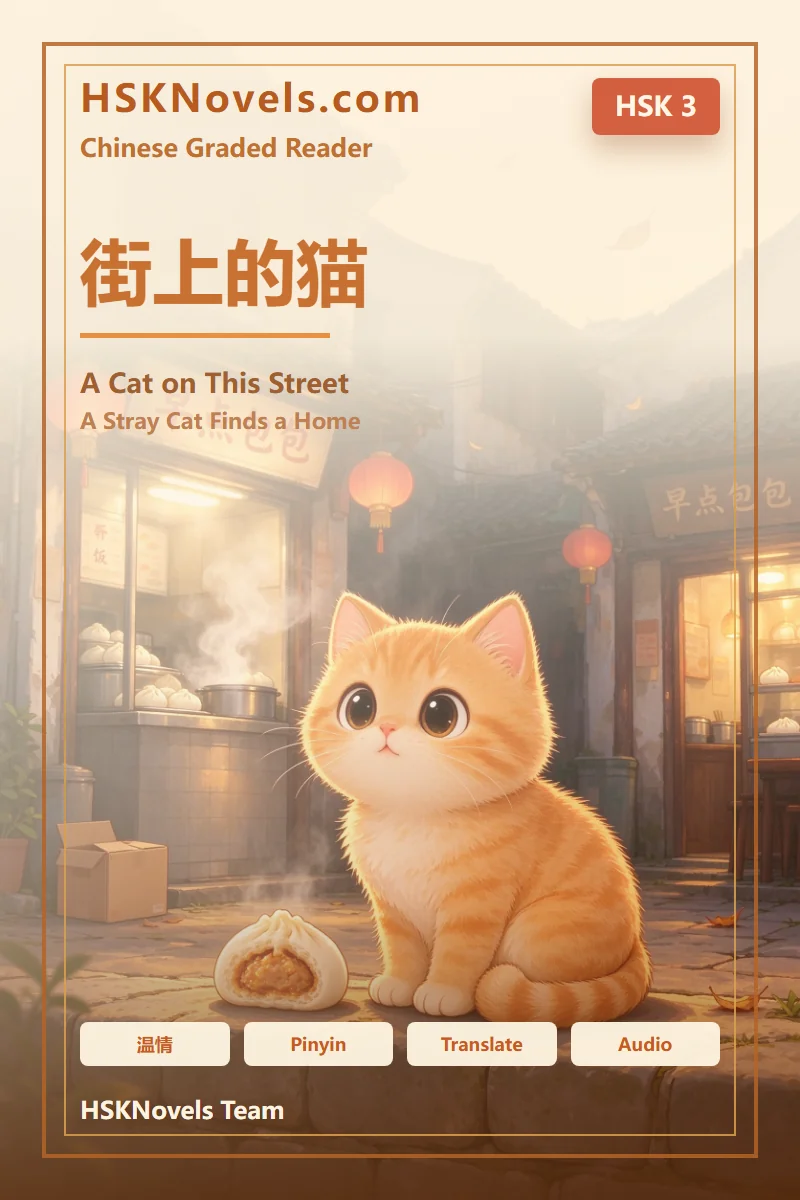
A Cat on This Street
Then a smell comes from behind a door. The light is on inside, and the ground at the doorway is dry. When the door opens, someone holds out half a warm baozi.
That is how it starts. Xiaohuang does not meet one person — he meets a street. The people who live there, the ones who chase him off, the ones who leave food out, a little girl named Doudou who decides he is hers, and a dog that runs at him every time he turns a corner. He is helped, fed, shooed away, and let back in, over and over, until he belongs to the whole street a little bit.
Then comes a night of snow, and a fever. He is too weak to move, and this time it is an old woman — a 奶奶 — who finds him, carries him inside, and keeps him. At the end he gets the thing he never had: a name of his own. 401 characters per chapter, average sentence length 12.8 characters.
It reads easily because there are almost no abstract words in it. Rain, baozi, a cardboard box, a dog, snow, a fever — things you can see. At HSK 3, “can I picture this” slows you down more than “do I know this character”.
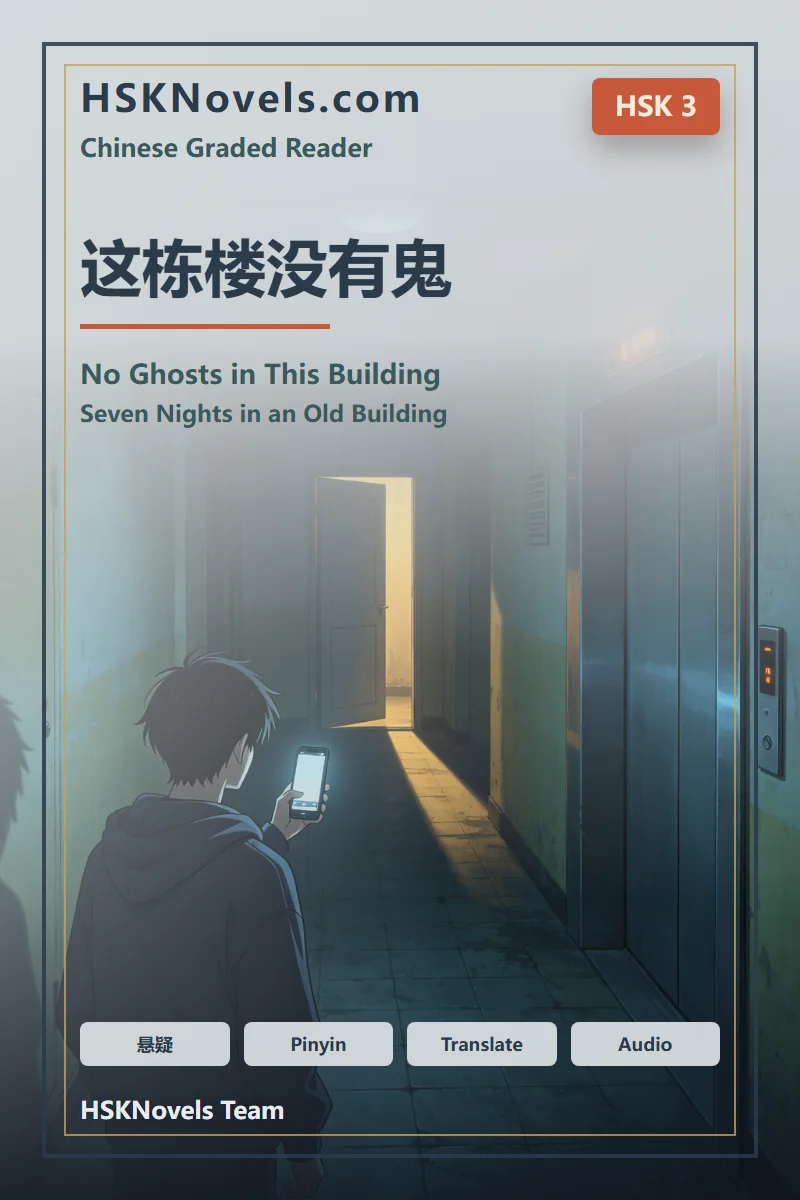
No Ghosts in This Building
Seven nights, seven small mysteries: The Sound in the Empty House, The Balcony Light, The Strange Elevator, The Closed Shop, The Face on the Grass, Someone Is Following Me, A Single Phone Call. Every one has an answer, and every answer turns out to be a person — a neighbour working late, a guard on the night shift, someone who cannot sleep.
441 characters per chapter, average sentence length 10.2 characters — the shortest in our whole catalogue. The reason to start here is suspense: when you want to know what happens next, you keep reading without needing willpower. You do not have to force yourself; you just want to know whether anyone was actually in that elevator.
Two Books to Skip for Now
Not because they are badly written. They are graded at HSK 4- now, and they are dense with proper nouns — 悟空, 妖怪, 金箍棒, or 势, 虚实, 迂直. Miss one name and the sentence breaks. Come back to them after the two books above.
One more note: in Chinese Wisdom Stories I, only 塞翁失马 (The Old Man Lost His Horse) is graded at HSK 3, and its sentences average 23.8 characters — more than twice the two books above. If you like idiom stories, remember it for later.
What to Read After HSK 3: Two Steps at HSK 4-
Step 1 — Bridge with five short pieces
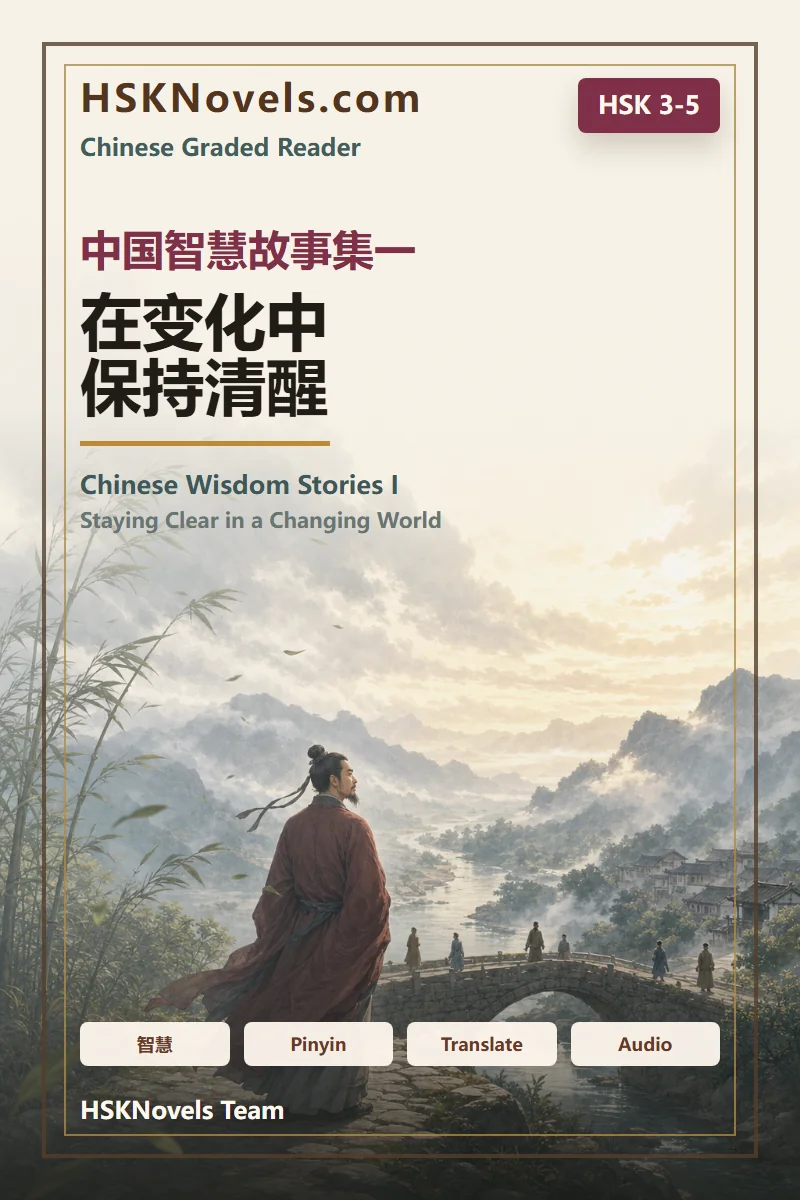
Each one stands alone; you get a complete story in ten minutes and do not have to remember anything from yesterday. Idiom stories also pay you back later, because you keep meeting them.
One thing worth knowing: this series is graded story by story, not published in four versions of the same book. In Volume I the ten stories break down as one HSK 3, four HSK 4-, four HSK 4+, and one HSK 5- — and the prologue is HSK 4+ as well. In Volume II only 曾子杀猪 is HSK 4-. Pick the pieces you want.
Chinese Wisdom Stories I
Step 2 — Your first full-length novel
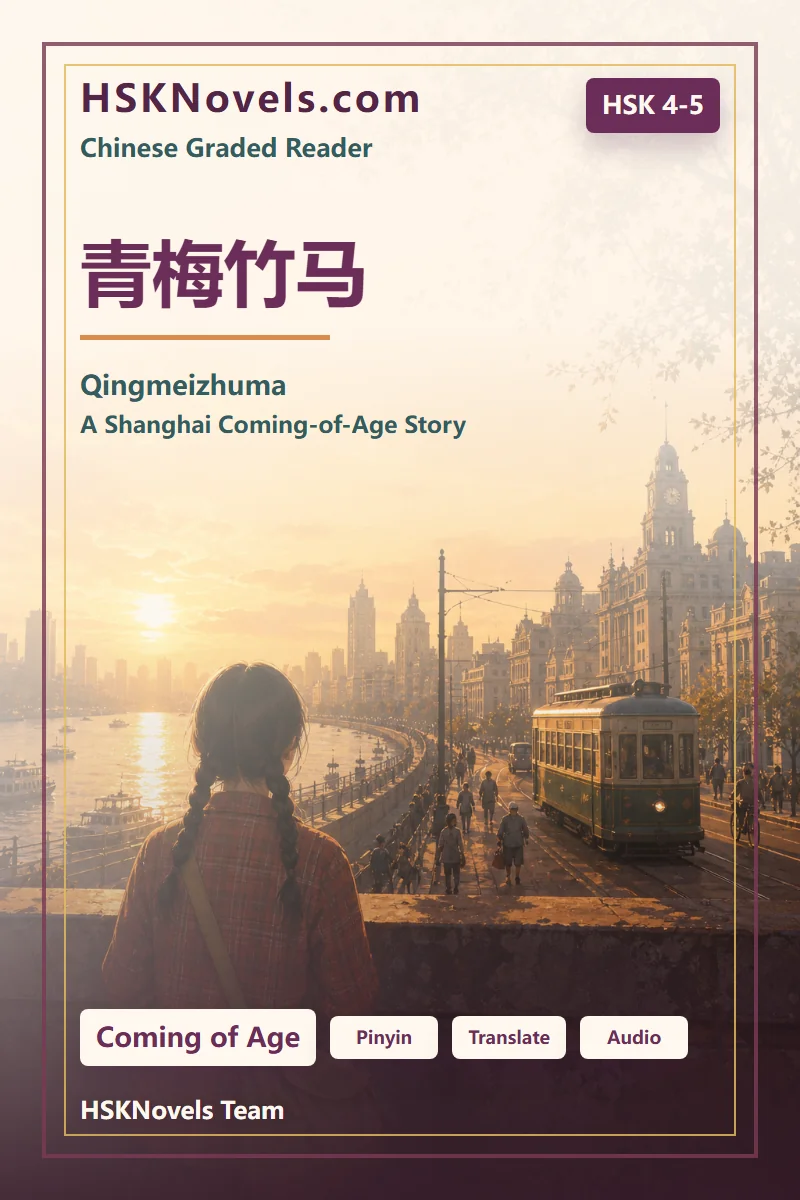
Qing Mei Zhu Ma
Ten chapters, around 860 characters each, with an HSK 5- version for a second pass. It is the HSK 4- book to read first: nothing in it depends on you first understanding an invented world. Classrooms, lanes, classmates, a grandmother — the subject is concrete, and that matters more than it sounds.
Before the Coffee Gets Cold: Save It for Later
We made this one at HSK 4- (all eight chapters) and HSK 5- (seven of them), and it is quiet and well made — but it is not the right first long book.
What is interesting is that its sentences are actually shorter than Qing Mei Zhu Ma’s (15.9 characters against 18.5). The difficulty is not the sentences. It is the setup: you have to assemble the rules of the time travel yourself, the dialogue carries a lot of meaning between the lines, and most of the feeling lives in what nobody says. For a native reader that is effortless. At HSK 4- it is extra weight you do not need yet.
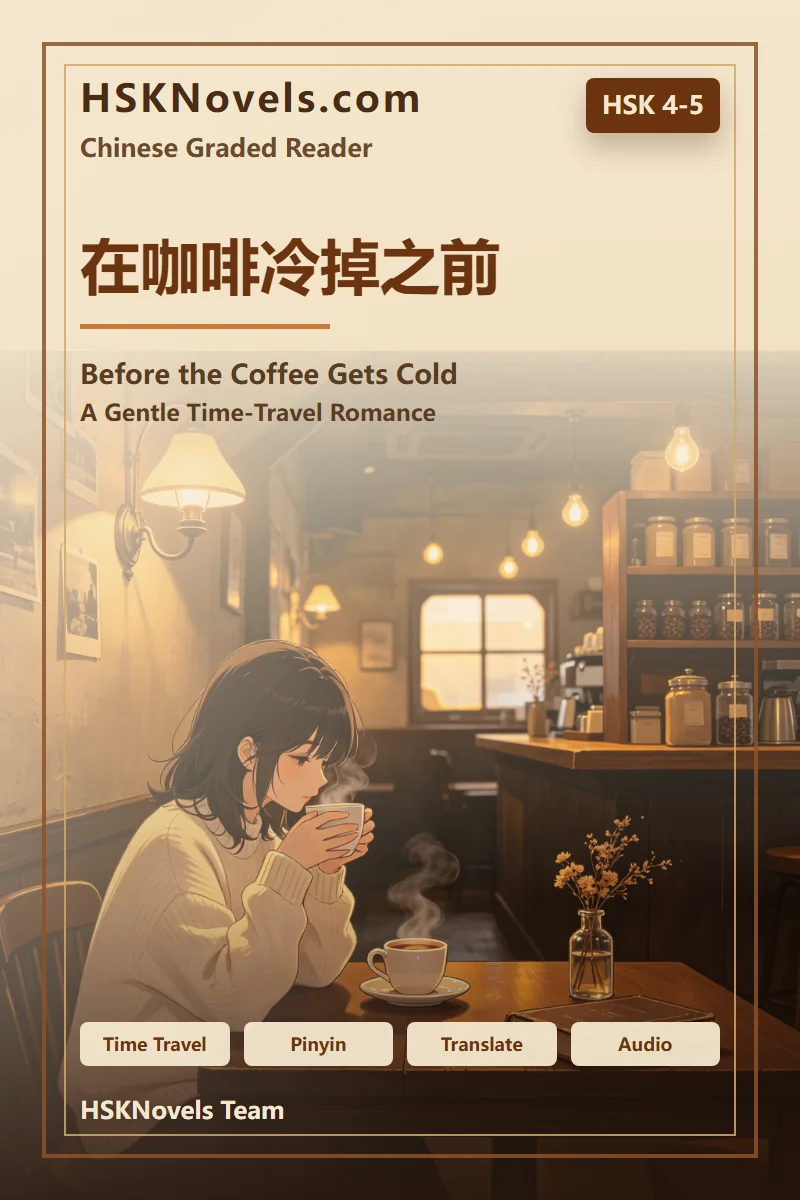
Before the Coffee Gets Cold
Six Books, Side by Side
| Book | Level | Chapters | Avg characters / chapter | Avg sentence | Best for |
|---|---|---|---|---|---|
| No Ghosts in This Building | HSK 3 | 7 | 441 | 10.2 | Your first book |
| A Cat on This Street | HSK 3 | 9 | 401 | 12.8 | Second book / warm stories |
| The Old Man Lost His Horse (Wisdom Stories I) | HSK 3 | 1 | 643 | 23.8 | Only if you like idioms |
| Chinese Wisdom Stories (HSK 4- pieces) | HSK 4- | 5 | 376–803 | ~23.7 | Bridging from HSK 3 |
| Qing Mei Zhu Ma | HSK 4- / 5- | 10 | 858 | 18.5 | Your first full novel |
| Before the Coffee Gets Cold | HSK 4- / 5- | 8 | 860 | 15.9 | Romance, once HSK 4- is easy |
A 14-Day Start Plan
- Days 1–2. Read chapter one. Get the gist. Look up nothing.
- Days 3–5. Same chapter, with the audio. Read along with it.
- Days 6–10. One chapter a day.
- Days 11–14. Go back and reread chapter one.
Five Mistakes Beginners Make
- Starting with simplified classics. Too many proper nouns; one name breaks a sentence.
- Starting with Chinese children’s books. The vocabulary is not controlled, which makes them harder than graded readers.
- Translating word by word. It breaks the flow, and you are tired by page three.
- Reading without listening. Chinese is a tonal language; skip the audio and you lose the strongest memory hook you have.
- Never rereading. Rereading is the only thing that turns a word you recognise into a word you know.
Frequently Asked Questions
Is HSK 3 enough to read Chinese stories?
Yes. Around 800 to 1,200 recognised characters is enough. HSK 3 graded readers run about 420 characters per chapter with sentences of ten to thirteen characters, and unknown words are held near 2%, so looking something up never interrupts a whole page.
How many Chinese characters do you need to read a book?
Around 800 to 1,200 for HSK 3 graded readers, and around 1,500 for HSK 4-. That means recognising characters, not writing them. Every line also carries pinyin, so an unknown character slows you down rather than stopping you.
Should you read Chinese with pinyin?
At the start, yes. Pinyin is not a crutch; it is how you attach a character to its sound. A useful routine is to read once without pinyin, read again with pinyin to check yourself, then listen to the audio. By the third pass most words no longer need it.
What is the difference between HSK 3 and HSK 4-?
HSK 3 is around 1,500 words and HSK 4- around 2,000. The bigger difference is in the sentences: HSK 3 graded readers average ten to thirteen characters per sentence, HSK 4- novels about fifteen to eighteen, and chapters grow from around 420 characters to around 860. Bridging with short pieces first helps.
Should beginners start with Journey to the West?
No. It is graded at HSK 4- on our site, and it is dense with proper nouns such as 悟空 (Sun Wukong), 妖怪 (monsters), and 金箍棒 (the golden staff). Miss one name and the sentence falls apart. Read the two HSK 3 books first and come back to it afterwards.
Why are Chinese children's books harder than graded readers?
Because children's books are not vocabulary-controlled. Chinese children understand words like 兴高采烈 or 蹑手蹑脚 because they have been hearing Chinese for years. Graded readers are written against the HSK word list with unknown words kept to a small percentage, which makes them the easier starting point.