Best Chinese Stories That Make You Laugh: Graded Novels for HSK Learners
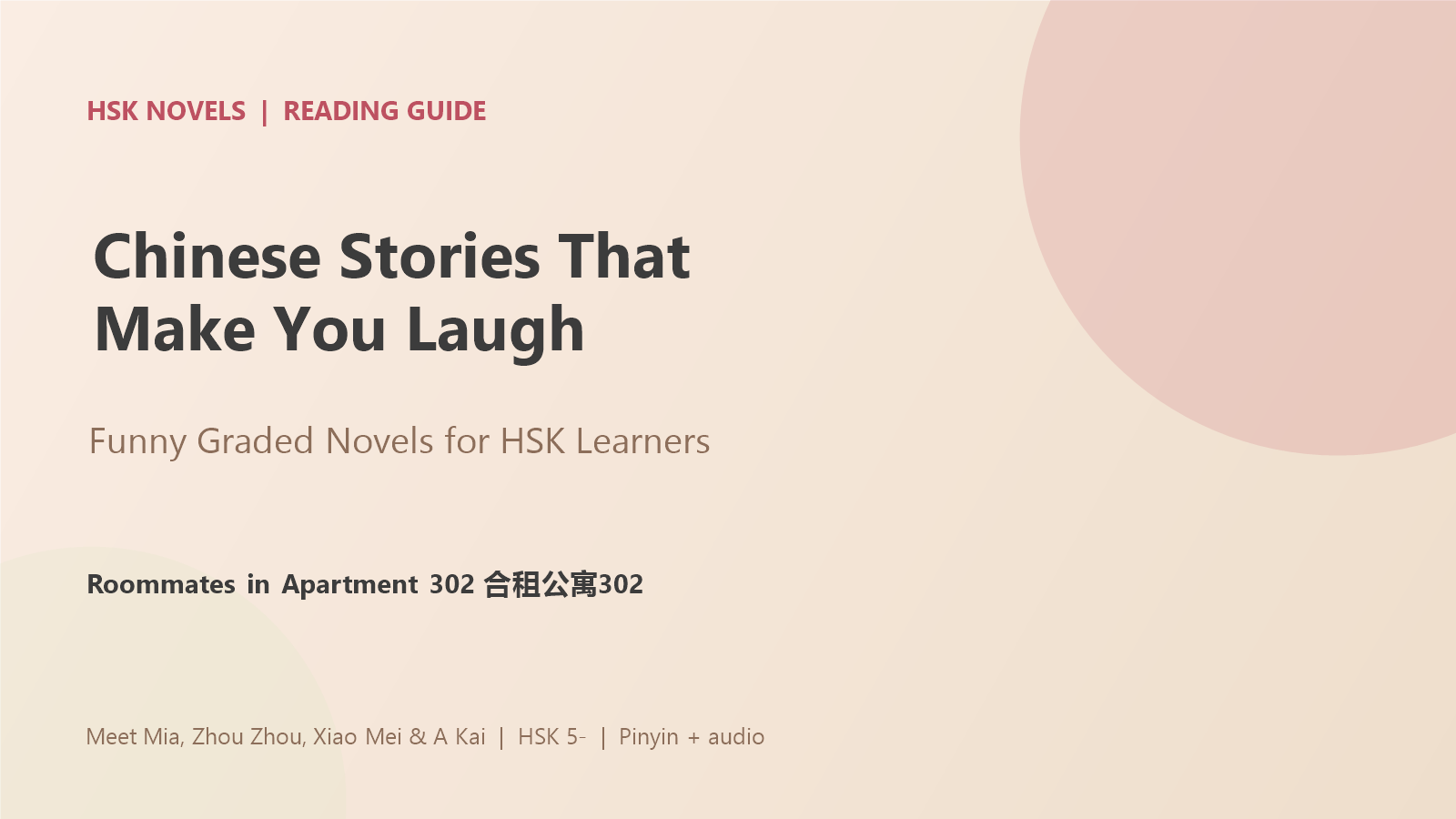
But humor is one of the most underrated tools in language learning. A story that makes you laugh gives you something textbooks cannot: the urge to keep reading. This guide explains why funny Chinese stories are powerful HSK reading practice, and introduces the first graded comedy novel for learners, Roommates in Apartment 302.
Why Humor Is the Missing Ingredient in Chinese Reading Practice
- Humor forces real comprehension. You cannot laugh at a joke you only half-understood. Getting the joke proves you understood the sentence, the situation, and the character's intention all at once.
- Laughter builds the reading habit. The strongest signal in reading data is whether a reader continues to the next chapter. Funny stories make people want the next chapter.
- Comedy teaches spoken Chinese. Jokes rely on slang, exaggeration, interjections, and everyday rhythms that textbooks avoid but real people use all the time.
- It lowers the fear of mistakes. When characters misunderstand each other and laugh, the reader relaxes. Making mistakes stops feeling like failure and starts feeling like the plot.
Roommates in Apartment 302: The First Graded Comedy Novel
- Zhou Zhou — a graduate student who dodges every chore with "I am writing my thesis" while ordering takeout.
- Xiao Mei — a designer who runs the apartment like a management project: duty rosters, fridge zoning, assessments.
- A Kai — a livestreamer who turns every moment of flat life into content and asks "Can I stream this?" about everything.
- Mia — who insists on French rituals (plating food, fork and knife for Chinese meals, la bise greetings) and keeps trying even when they backfire.
Joke × Language: What Each Scene Teaches You
Mia greets her new flatmates with la bise (cheek kisses) — and the whole apartment freezes. A Kai's livestream title says it all: "French Roommate Kissed Me on the First Day?!"
📚 The language it teaches:
Social-distance vocabulary: 打招呼, 拥抱, 亲一下, 太热情, 不习惯 — the words you actually need when body language and Chinese culture collide.
Read Chapter 1: The New Resident of 302 →
Xiao Mei posts a printed duty roster on the fridge with an "Excellent, Good, Poor" rating column — and a rule that three "Poor" ratings means buying bubble tea for everyone. A Kai asks: what about three "Excellent" ratings?
📚 The language it teaches:
Housework and assessment language: 值日表, 考核, 评分, 连续三次, 请客 — plus the conditional patterns 要是…就… and 连续三次…的人 that learners meet constantly in real life.
Read Chapter 4: Duty Roster →
A Kai's white T-shirt comes out of the washing machine pink. He launches a full investigation: "Who put something red in the washing machine?!" His livestream "Room 302 Washing Machine Case Solved" goes viral.
📚 The language it teaches:
Conflict and investigation language: 洗衣机, 染成, 调查, 破案, 谁…? — the question forms and verb-complement structures (洗完了, 变成了粉色) that carry everyday arguments.
Read Chapter 7: The Washing Machine War →
Mia declares the first "302 Sino-French Fusion Dinner" a success. She corrects everyone: "It's not fusion. It's takeout plus French food." The group cheers anyway.
📚 The language it teaches:
Food and celebration vocabulary: 晚宴, 外卖, 干杯, 圆满结束, 宣布 — plus the joke patterns of correction: 不是…是… and 都一样.
Read Chapter 9: The Weekend Family Dinner →
A Kai says "family" (家人们) to his livestream audience and treats everything — even washing machines and candlelight meetings — as content. The question "Can I stream this?" becomes his catchphrase.
📚 The language it teaches:
Internet and livestream slang: 家人们, 直播, 弹幕, 点赞, 上热门 — the modern spoken Chinese that textbooks rarely teach but that HSK 5 learners will hear every day.
Read Chapter 3: Whose Kitchen Is It? →
How to Read a Comedy Chapter (3 Steps)
- Read once for the plot. Do not stop at every word. Follow who said what and who is annoyed with whom.
- Read again for the joke. Ask yourself: why is this funny? The answer is usually a cultural clash, a misunderstanding, or a mismatch between words and reality — and noticing that is language learning.
- Listen and shadow-read. Comedy lives in tone and timing. Listen to the audio and repeat the punchlines out loud.
More Funny Chinese Stories for HSK Learners
- I Start Living in Chinese: The New Classmate (HSK 4+) — the first book: an Italian exchange student survives dormitory life, cafeteria food, and classroom culture.
- My Part-Time Job Diary in China (HSK 4+) — the second book: a German student faces his first job, from residence permit procedures to a busy weekend and an angry customer.
- Roommates in Apartment 302 (HSK 5-) — the third book: four flatmates, four obsessions, one apartment.
Frequently Asked Questions
Can HSK 4 learners read this comedy novel?
Roommates in Apartment 302 is written for HSK 5- level, but the story and jokes are supported by pinyin, translation, and audio. If you are finishing HSK 4, start with the first two books of the Living in Chinese series (HSK 4+) and work up to this one.
Will I understand Chinese humor?
The humor here is not about wordplay or classical allusions. It is situational — cultural clashes and misunderstandings — which works for learners from any background.
Do funny stories help with HSK 5 exams?
Yes. Comedy trains context comprehension, implied meaning, and everyday spoken vocabulary, which appear in HSK 5 reading and listening passages.
What is the best way to read a comedy chapter?
Read once for the plot, once for the joke, then listen to the audio and repeat the punchlines. If you can explain why a scene is funny in your own words, you understood the Chinese.
Are there other funny Chinese graded stories?
The Living in Chinese series is the most consistent source of light-hearted daily-life comedy for learners. You can also read our full guide to the best Chinese novels for HSK 3-5 for more options by level.