【历史系列:六】元朝:马背上建立的帝国
Yuan Dynasty: An Empire Built on Horseback
HSK4+历史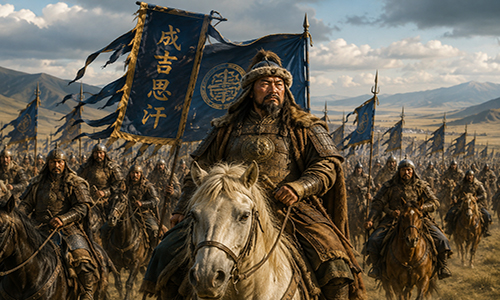
Before the Yuan Dynasty, Chinese dynasties were all based on agriculture.
The emperor lived in cities, and the country mainly relied on land and grain for living.
However, the Yuan Dynasty was very special.
Its founders came from the Mongolian grasslands.
They mainly engaged in herding and hunting, living a completely different life.
1. Genghis Khan on the Grasslands
A long time ago, many tribes lived on the Mongolian grasslands.
Wars often occurred between these tribes. They plundered land, cattle, and people.
In this chaotic environment, a young man named Temujin gradually grew up.
Later, he unified the Mongolian grasslands.
People called him 'Genghis Khan'.
The most formidable thing about the Mongols was their cavalry. The Mongol cavalry was fast and had strong combat effectiveness.
Genghis Khan was also very good at leading armies.
The Mongol cavalry soon became the most fearsome army in the world.
2. The Mongol Cavalry Sweeping the World
After unifying the grasslands, the Mongol army began to expand its territory continuously.
They successively destroyed powerful neighboring countries in the north, and later even reached Europe.
The Mongol army moved very fast. They often appeared suddenly and left suddenly.
Many cities were not yet prepared, and the war was already over.
At that time, Europe considered the Mongols as an 'army from hell'.
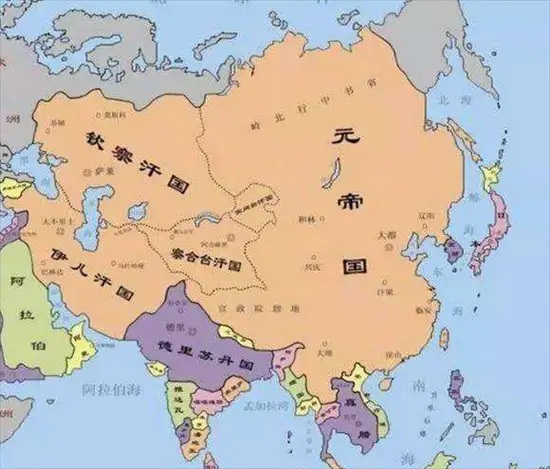
At its peak, the Mongol Empire spanned Asia and Europe.
However, the Mongols were good at fighting but not necessarily at governing a country.
As the empire grew larger, problems gradually emerged.
Later, the Mongol Empire slowly split into several parts.
The part ruled by Kublai developed into the Yuan Dynasty.
3. Kublai Established the Yuan Dynasty
Kublai was the grandson of Genghis Khan.
Unlike many Mongol nobles, Kublai was very interested in Han Chinese culture.
He learned the culture of the Central Plains and began to govern the country like a Chinese emperor.
In 1271 AD, Kublai formally established the Yuan Dynasty.
He set the capital at Dadu, which is today's Beijing.
At that time, southern China was still controlled by the Southern Song.
To unify the country, the Yuan continued to attack southward.
After years of war, the Southern Song finally fell.
China was once again unified.
For many Mongol nobles, China was just a part of the empire.
But Kublai hoped to establish a truly stable dynasty.
Therefore, he extensively used Han Chinese officials and learned the governance methods of Central Plains dynasties.
However, the lifestyle on the grasslands was very different from that of the Central Plains.
4. Conflict Between the Grasslands and the Central Plains
After the Yuan Dynasty was established, a big problem emerged.
That is: How could the people of the grasslands manage a huge agricultural country?
The Mongols were accustomed to grassland life. They were not used to settled agricultural life.
The Central Plains had many cities, farmlands, and populations. The management of the country was also more complex.
Although the Yuan learned much from the Central Plains, they still retained many Mongol practices.
Moreover, the Yuan divided people into different classes.
Mongols had the highest status, followed by other ethnic minorities and foreign immigrants. Han Chinese had the lowest status.
Moreover, Mongol nobles did not truly understand agricultural society.
They were more accustomed to war and expansion.
Therefore, the Yuan Dynasty always had many contradictions.
However, the Yuan also brought some new changes.
Because the Mongol Empire unified many regions, trade and personnel exchange became easier.
Many foreign merchants, travelers, and missionaries came to China.
One of the most famous among them was Marco Polo from Europe.
Later, he wrote stories about China, letting many Europeans know for the first time about the prosperity of the Eastern world.
5. The Short and Chaotic Yuan Dynasty
Although the Yuan completed unification, it did not last long.
After Kublai's death, subsequent emperors became increasingly powerless.
The royal family constantly fought for power. The country became increasingly chaotic.
At the same time, wars caused economic problems for the country.
The people's lives became increasingly difficult.
Natural disasters also occurred frequently.
In the late Yuan, peasant uprisings broke out in many places.
More and more people began to resist Yuan rule.
At this point, the Yuan could no longer truly control the country.
6. The Fall of the Yuan Dynasty
Later, a young man from a poor background appeared.
He was the later Zhu Yuanzhang.
Eventually, Zhu Yuanzhang led his army into the Yuan capital.
The Yuan rulers fled back to the northern grasslands.
In 1368 AD, the Yuan Dynasty officially fell.
Although the Yuan lasted less than a hundred years, it had a great impact on Chinese history.
The Yuan Dynasty was the largest dynasty in Chinese history by area.
Beijing became the empire's capital for the first time.
To this day, people can still see the historical traces left by that 'empire on horseback'.