【历史系列:四】万国来朝:伟大的唐朝
All Nations Paying Homage: The Great Tang Dynasty
HSK4+历史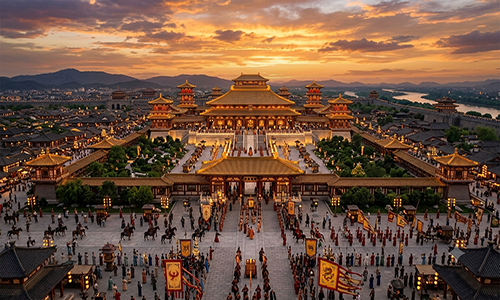
After the Han Dynasty fell, China entered a long period of chaos.
One country after another appeared and quickly perished.
Many common people did not even know which country they were in.
During this time, northern ethnic groups continuously entered China. The Han and other ethnic groups began to interact.
The people struggled to live amidst the chaos.
This situation lasted for over 400 years until a truly powerful dynasty finally emerged.
It was the Tang Dynasty.
1. The Mighty Man Li Shimin and the Founding of the Tang Dynasty
To resist the cruelty of the Sui Dynasty, Li Yuan started an uprising.
Li Yuan had a son named Li Shimin.
Li Shimin was a formidable warrior in his youth. Facing northern cavalry and separatist forces, he almost always achieved victory.
During the founding of the Tang Dynasty, he earned the greatest military merits and was granted the title 'Heavenly Strategy General' by Li Yuan.
Later, Li Shimin killed his own brothers in a power struggle and became the new emperor, later known as Emperor Taizong of Tang.
Li Shimin was indeed a very capable emperor.
He knew how to employ people and was willing to listen to the advice of his ministers.
There was a minister named Wei Zheng who often criticized Li Shimin to his face. But Li Shimin did not get angry; he seriously accepted Wei Zheng's advice.
In Chinese history, there were not many emperors like this.
During Li Shimin's reign, agriculture recovered and developed, and people's lives began to improve.
He also defeated the powerful Eastern Turkic Khaganate in the north. He established his influence in the Western Regions and reopened the Silk Road.
In history, this period is called the 'Zhenguan Reign'.
2. All Nations Paying Homage: The Prosperity of the Tang Dynasty
After many years of development, around the time of Li Longji, the Tang Dynasty entered its most powerful period.
At that time, Chang'an was the largest city in the world.
People from Japan, Korea, Central Asia, Persia, and even Arabia came to Chang'an to study, do business, or live.
On the streets, one could see foreigners wearing different clothes and speaking different languages.
Many foreign envoys were astonished by this country after arriving in the Tang.
Because the Tang Dynasty at that time was extremely prosperous.
Inside Chang'an, there were bustling markets and goods from all over the world. Some sold spices, some sold gems, and others performed foreign dances.
For many foreigners, Chang'an was like the center of the world.
Japan sent many 'Tang envoys' to China, hoping to learn the knowledge and culture of the Tang.
Even today, traces of the Tang can be seen in some Japanese architecture, writing, and cultural practices.
Besides its strong economy, Tang culture also reached a very high level.
This was the most glorious era of Chinese poetry.
Poets such as Li Bai, Du Fu, and Wang Wei lived during this period.
Even today, Chinese people still recite their poems.
3. The Decline of a Golden Age
However, no matter how powerful a dynasty is, it cannot prosper forever.
In the later years of Li Longji's reign, the power of local armies grew increasingly strong.
This laid the groundwork for the subsequent disaster.
Soon after, An Lushan, who commanded a large army, launched a rebellion.
This war lasted for many years and is known in history as the 'An-Shi Rebellion'.
The war reduced many cities to ruins, caused massive casualties among the people, and the once-prosperous Tang Dynasty began to decline rapidly.
4. Struggling Efforts
After the An-Shi Rebellion, although the Tang did not immediately collapse, it had lost its former strength.
The central government found it increasingly difficult to control the regions.
Some local armies even stopped obeying the emperor's orders.
Moreover, severe struggles emerged within the court.
Eunuchs, officials, and local powers constantly fought for power.
The emperor could not truly control the entire country.
Despite this, the Tang still strove to maintain its rule.
Some emperors attempted reforms, hoping to restore the nation's strength.
Under these difficult circumstances, the Tang still endured for over a hundred years.
5. The Fall of the Tang Dynasty
In the late Tang, a general named Zhu Wen forced the 17-year-old emperor to abdicate the throne to him.
The Tang Dynasty, which had ruled for 289 years, finally fell.
From 618 to 907, the Tang Dynasty lasted about three hundred years.
In Chinese history, the Tang Dynasty was a dynasty with tremendous influence.
After the Tang fell, China entered another period of division.
But many people miss that open, confident, and powerful era.
Even today, Chinese people sometimes still refer to themselves as 'Tang people'.
Abroad, places where many Chinese people gather and live are called 'Chinatowns'.
6. The Greatness of the Tang Dynasty
Why do so many people like the Tang Dynasty?
Because in the eyes of many Chinese, the Tang was not only powerful but also open.
It was willing to communicate with the outside world and accept different cultures.
Moreover, the Tang left behind many excellent poems and works of art.
For later China, the Tang was not just a dynasty, but more like an 'ideal era'.
Of course, the Tang had its shortcomings.
It also had wars, power struggles, and the suffering of ordinary people.
But precisely because of this, people can more easily feel that no matter how great an era is, it will come to an end one day.
Yet the cultural influence left by the Tang has been preserved to this day.