花江峡谷大桥:贫困山区里的世界最高桥
Huajiang Canyon Bridge: The World's Highest Bridge in a Poor Mountain Area
HSK5+纪实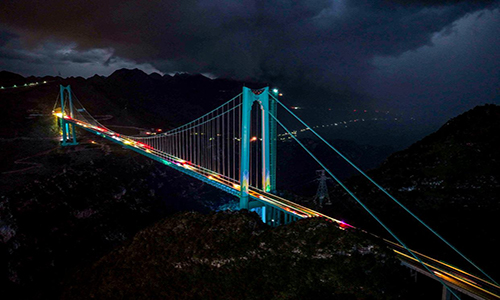
When I first came to Guizhou, I truly understood what 'world of mountains' means.
After the car left the city, the tall buildings outside the window gradually disappeared, replaced by one gray-green mountain after another. Those mountains were connected without end.
The highway was like a thin thread, winding around the cliffs. Sometimes, just after the car turned a corner, a bottomless canyon would suddenly appear before my eyes.
In the morning, the fog in the mountains had not yet dispersed.
White mist slowly rose from the bottom of the valley, covering the distant villages and mountain roads bit by bit.
The mountains in Guizhou were completely different from those I had seen before. Here, there were tall and steep rocky mountains everywhere, and the highway was often built along the cliffs.
Gradually, the car drove out of the valley. Ahead appeared a wide road.
Continuing forward, a huge bridge suddenly appeared.
It connected two large mountains. The pillars supporting the bridge rose high, and clouds and mist swirled below the bridge, making the whole bridge seem to float among the mountains.
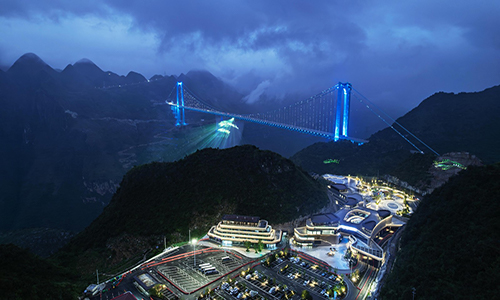
At that moment, I was so stunned that I almost forgot to speak.
Later I learned that the bridge before me was the Huajiang Canyon Bridge. The world's highest bridge.
But what really struck me was not just the words 'world's highest'.
I could hardly imagine how people managed to build the bridge in the depths of such mountains.
Looking down from the bridge, the canyon was so deep that it made people dizzy. I learned that there was almost no flat land here before, and transporting materials was very difficult. Some places were even inaccessible to large machinery, so much equipment had to be transported into the mountains bit by bit.
More importantly, Guizhou Province was once one of the poorest regions in China.
Because of too many mountains and difficult transportation, Guizhou had long been underdeveloped. In the past, people described Guizhou as: 'No three li of flat land, no three liang of silver per person.'
Two places in the mountains that looked close together might take several hours to drive around. When it rained, the mountain roads were easily damaged; after icing in winter, some roads were too dangerous to drive on. For people living on the plains, it was hard to understand what 'difficulty going out' really meant.
That middle-aged driver said that when he was young, he was most afraid of driving on mountain roads.
"Before, when I went home from the county town, I could only ride a motorcycle, and it took several hours just on the road," he said. "Sometimes on rainy days, rocks would suddenly fall from the mountain, and I could only pray they wouldn't hit me."
He smiled and added:
"Now it's much better. Adults can go out, and children can go to school."
At that moment, I suddenly began to understand why China was willing to pay such a high cost to build bridges in the mountains.
For many people in the mountainous areas, a bridge is not just a bridge.
It means the road home.
In the past, after some young people left the mountains, they rarely came back. Not because they didn't want to, but because they couldn't. Some could only return once a year; some could only see their parents once every few years.
But when highways and bridges were gradually built, many things began to change.
A trip that originally took four or five hours now might take only one hour. Fruits that were hard to sell before can now be delivered to cities outside faster. More and more tourists come to the mountainous areas, and some young people are even considering returning to work in their hometowns.
But what I remember most was a sentence the driver later said.
He said: 'Before, my son worked in another place; even three days off wasn't enough time to come home. Now that the bridge is built, he suddenly told me a few days ago that he wants to come back and visit.'
When he said this, there was no excited expression on his face, but his eyes, no longer bright, were slightly moist.
In his eyes, the bridge was never just the 'world's highest'.
It is the opportunity for mountain children to see the outside world.
It is the hope of old people waiting for their children to come home.
It is the road home for those away from home.
On the day I left Guizhou, I passed that bridge again.
The setting sun shone on the bridge, which quietly spanned the mountains. The canyon below was still bottomless, and the mountain fog in the distance had not yet dissipated.
I suddenly felt that the places once separated by the mountains seemed to be gradually connecting.
Perhaps, this is today's China.
It still has many difficulties, and many places are still slowly developing. But at the same time, countless new roads, high-speed railways, and bridges are reconnecting those distant places.
And change often begins just like this.