第一次在中国过年,我才知道红包不能随便拿
My First Chinese New Year: I Learned That Red Envelopes Cannot Be Taken Casually
HSK5-文化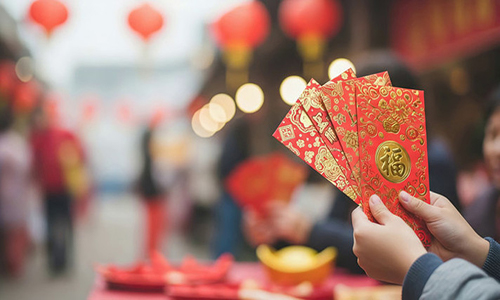
As an international student, I celebrated the Spring Festival for the first time last year. My friend Xiaolin invited me to his home for the New Year.
Before that, I always thought the Spring Festival was just a lively festival. People eat together, set off fireworks, and then rest for a few days. However, that experience made me truly understand the Chinese Spring Festival for the first time.
On New Year's Eve, Xiaolin's home was especially lively. Red couplets were pasted on the door, the character 'Fu' was hung in the living room, and someone was making dumplings in the kitchen.
I arrived a bit late, just in time for the New Year's Eve dinner. As soon as I entered, Xiaolin's mother urged me to eat. She kept telling me to eat more and kept putting food in my bowl.
After the New Year's Eve dinner, everyone sat together watching the Spring Festival Gala. A few children ran around, laughing and paying New Year's greetings to the elders. Just then, Xiaolin's grandmother suddenly took a red envelope out of her pocket and, smiling, handed it to me.
I was stunned. 'Is this for me?' I asked shyly. 'Of course, it's your first Chinese New Year in China, you should get lucky money too,' Grandma said with a smile.
I had heard before that Chinese people give red envelopes during the New Year, but I always thought they were just ordinary gifts. So I immediately took the red envelope and opened it in front of everyone. I even subconsciously glanced at how much money was inside.
Unexpectedly, the lively room suddenly quieted for a moment. I immediately felt that something was not quite right.
Later, Xiaolin quietly pulled me aside and whispered to me, 'In China, red envelopes are usually not opened right away.' I was surprised: 'Why? In our country, opening a gift immediately shows happiness and gratitude.' Xiaolin smiled and patiently explained.
He said that red envelopes given by elders to younger ones are usually called 'yā suì qián'. What matters is not the amount of money, but a kind of blessing and care. The elders hope the child will have a peaceful new year, so they give red envelopes. 'If you open it immediately, others might think you care about the money inside, not their feelings.' I finally understood that red envelopes are not just money, but represent a kind of affection.
However, something else surprised me even more. Later, when Grandpa gave me a red envelope, I was about to take it directly. Xiaolin gently touched my arm. I noticed that the children nearby, while accepting red envelopes, would say, 'No, no, thank you, Grandpa.' Although they would eventually take it, they would first be polite and refuse a few times.
I quietly asked Xiaolin, 'Since everyone wants to take it, why do they first refuse?' Xiaolin smiled and said, 'This is a traditional custom. Chinese people value politeness. Often, people will first be modest and refuse. They won't accept it directly.' After hearing this, I suddenly felt that many Chinese behaviors seem a bit complicated, but behind them are all related to 'renqing' (human relationships).'
The Spring Festival is not just a festival. For many Chinese people, it is more like an opportunity for the whole family to reunite. Red envelopes, New Year's Eve dinner, New Year greetings – perhaps what really matters in these customs is not the form, but the feelings between people.
The next day, Xiaolin and I went out together to buy some small gifts for the elders at home. Xiaolin told me that Chinese people value 'reciprocity of etiquette' very much. When others are good to you, you also want to give your feelings back.
That day, for the first time, I felt that the warmest part of the Spring Festival might not be the red envelopes, but the special care between people.